
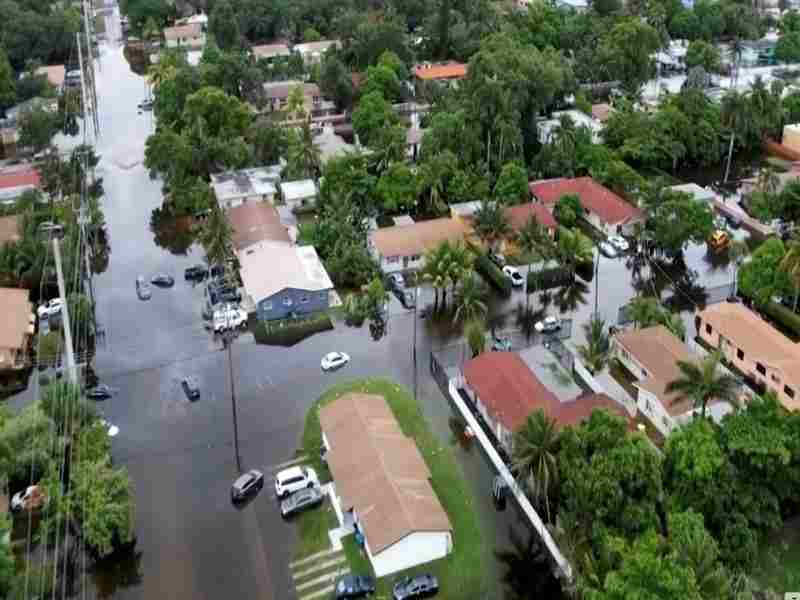
South Florida is facing an elevated coastal flooding threat as unusually high tides, strong northeast winds and seasonal king tides combine to push water levels toward major flood thresholds in parts of the region.
The greatest concern is along Florida’s Atlantic coast, including areas from Palm Beach County through Miami-Dade County and into the upper Florida Keys, where high tides could flood low-lying roads, waterfront neighborhoods and other vulnerable coastal areas.
The South Florida Water Management District said tidal water levels along the region’s east coast may remain above the National Weather Service’s Moderate Flooding threshold, with some locations approaching the Major Flooding threshold during the current peak period.
Miami, Fort Lauderdale and West Palm Beach Face Flood Risk
Communities including West Palm Beach, Fort Lauderdale, Miami and Homestead are among the areas facing increased coastal flooding risk.
Water may rise onto roads and parking areas near canals, bays and the Intracoastal Waterway during periods of high tide.
Residents in low-lying coastal communities could also experience saltwater flooding even without significant rainfall, a common feature of South Florida’s king tide season.
The region’s vulnerability is being increased by persistent northeast winds, which can push additional ocean water toward the coast.
Local weather reports have warned of sustained winds around 20 to 25 mph, with stronger gusts reaching roughly 30 to 40 mph in some coastal and metropolitan areas.
Strong winds may also bring down tree limbs, move unsecured outdoor objects and contribute to isolated power outages.
What Is Causing the Flooding?
The primary driver is a period of exceptionally high astronomical tides known as king tides.
King tides occur when the gravitational forces of the moon and sun combine to produce some of the highest naturally occurring tides of the year.
They do not require a hurricane or tropical storm to cause flooding.
Instead, unusually high tides can push ocean and bay water into streets, drainage systems and low-lying neighborhoods.
The South Florida Water Management District said high tides along the east coast are expected to remain elevated during the period from October 26 through November 12, with the annual maximum predicted peak occurring around October 27.
In the Florida Keys, annual maximum predicted tidal peaks are expected around October 28 and October 30.
Major Flooding Threshold Possible
The latest tidal outlook covers the period from October 26 through November 3.
According to the district, water levels along South Florida’s east coast could remain above the Moderate Flooding threshold in the coming days.
Some locations may approach the Major Flooding threshold, while water levels could remain above the Minor Flooding threshold through the weekend.
Conditions in the Florida Keys are also elevated, with tidal levels near or above the Moderate Flooding threshold in some locations.
By comparison, South Florida’s Gulf Coast is expected to experience less severe tidal impacts, with water levels generally remaining below the Minor Flooding threshold.
Strong Winds Can Make King Tide Flooding Worse
Astronomical tides alone do not determine how high the water ultimately rises.
Wind direction, wind speed, ocean currents and atmospheric conditions can all push actual tides above or below predicted levels.
Persistent northeast winds are particularly important for South Florida because they can drive Atlantic water toward the coastline.
That combination can increase flooding around canals, bays and coastal neighborhoods even when rainfall is limited.
The South Florida Water Management District specifically incorporates wind strength, direction and ocean currents into its weekly tidal outlooks because those conditions can significantly change local water levels.
Drivers Should Avoid Flooded Roads
Coastal flooding can create significant transportation problems, particularly around high tide.
Roads near the waterfront may become temporarily impassable, and saltwater flooding can make it difficult to judge road depth.
Drivers should avoid attempting to cross flooded streets and should be particularly cautious in areas that regularly experience king tide flooding.
Residents should also secure lightweight outdoor furniture, trash containers and other loose objects because of the strong winds.
People living in flood-prone neighborhoods may want to move vehicles away from low-lying streets before the next high-tide cycle.
King Tide Season Continues Into November
The current flooding threat is part of South Florida’s broader 2026 king tide season.
The water management district has identified several periods when unusually high tides are expected through the remainder of the year.
Along the east coast, another significant king tide period is forecast from November 22 through November 29, followed by another from December 22 through December 27.
The Florida Keys face an even longer period of elevated tidal activity, with high tides expected through much of November.
South Florida has hundreds of miles of shoreline and numerous canals and coastal water-control structures, making the region especially sensitive to combinations of rainfall, storm surge and exceptionally high tides.


