
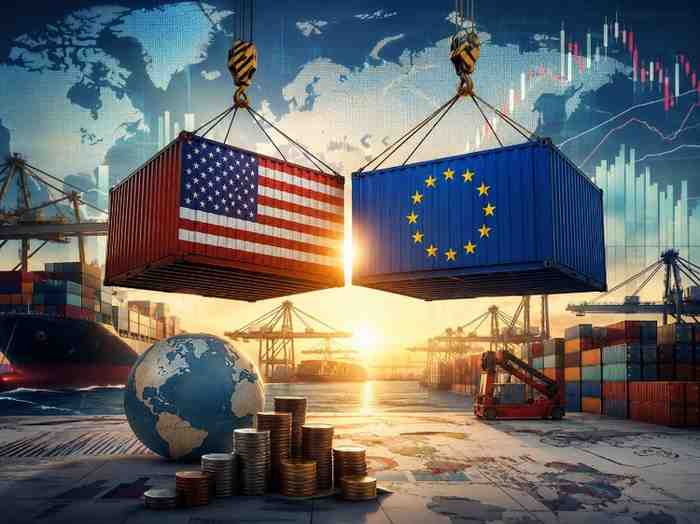
The global economy is feeling the impact of a new wave of U.S. tariffs in 2026, with businesses, consumers, and governments increasingly grappling with higher costs, disrupted supply chains, and growing uncertainty over the future of international trade.
At the center of the debate is the evolving trade relationship between the United States and the European Union. While Washington and Brussels reached a trade agreement in 2025, recent tariff announcements and policy shifts have reignited concerns among manufacturers, exporters, and investors on both sides of the Atlantic.
Economists warn that the consequences extend far beyond trade negotiations. From rising consumer prices to shifts in global manufacturing hubs, tariffs are increasingly shaping the business landscape in 2026.
A Trade Relationship Worth Trillions
The stakes are enormous.
According to the European Commission, the EU-US partnership remains the world’s largest bilateral trade and investment relationship, with approximately €1.6 trillion ($1.8 trillion) in goods and services trade recorded in 2024. More than €4.2 billion worth of goods and services cross the Atlantic every day. Total investments between EU and U.S. firms exceeded €5.3 trillion.
Latest European Union data show that annual EU-US trade now reaches roughly €1.7 trillion, while total bilateral goods trade exceeded €910 billion in 2025. The United States remains the EU’s largest trading partner, while the EU is America’s most important economic partner.
Despite this deep economic integration, tariffs have emerged as a major source of friction.
Why the US Is Using Tariffs
The Trump administration argues that tariffs are necessary to protect American industries, reduce trade deficits, encourage domestic manufacturing, and strengthen economic security.
Since 2025, Washington has imposed various tariffs on imports from multiple trading partners, including the European Union, China, and several emerging economies. Some duties have reached 15% or higher, depending on product categories and trade negotiations.
Supporters argue that tariffs encourage companies to manufacture products within the United States. Critics, however, say the policy ultimately raises costs for businesses and consumers.
Trade Flows Already Showing Signs of Stress
The effects are becoming increasingly visible.
According to Eurostat data cited by Euronews, EU exports to the United States fell by nearly 30% during the first quarter of 2026 compared with the same period a year earlier. The decline represents one of the sharpest slowdowns in transatlantic trade in recent years.
Yet despite trade tensions, overall commerce remains substantial. Research from the American Chamber of Commerce to the EU found that US-EU goods trade reached a record $1.05 trillion in 2025, demonstrating the resilience of the economic relationship even amid tariff disputes.
Industries Facing the Biggest Impact
Technology Sector
Technology companies remain among the most vulnerable to tariff-related disruptions.
Many major firms rely on globally sourced semiconductors, processors, batteries, and electronic components. Tariffs increase import costs, forcing businesses to either absorb losses or pass higher expenses on to customers.
Industry analysts note that hardware manufacturers are increasingly exploring alternative production locations in India, Vietnam, and Malaysia as a hedge against trade uncertainty.
Automotive Industry
The automotive sector has become another major battleground.
Modern vehicles often contain thousands of components sourced from multiple countries. Tariffs on steel, aluminum, batteries, and vehicle parts increase manufacturing costs throughout the supply chain.
For electric vehicle manufacturers, the challenge is even greater because battery production depends heavily on globally integrated supply networks.
Agriculture
Farmers and agricultural exporters have frequently found themselves caught in the middle of trade disputes.
Products including dairy, grains, meat, wine, and processed foods often become targets for retaliatory measures. As tariffs increase, exporters face reduced competitiveness in international markets.
Manufacturing and Industrial Goods
Manufacturers are dealing with rising input costs, especially for machinery, metals, and industrial components.
The result is a growing pressure on profit margins and investment decisions, particularly among small and medium-sized businesses.
Consumers Are Paying More
One of the most significant consequences of tariffs is their effect on inflation.
Research published by the Federal Reserve Bank of San Francisco found that tariffs can initially suppress demand but ultimately contribute to higher prices for goods and services as costs move through the supply chain.
Recent inflation data highlight these concerns.
U.S. consumer inflation reached 4.2% in May 2026, the highest level in three years. While energy prices linked to geopolitical tensions have been a major contributor, economists also point to tariffs as an important source of upward pressure on prices.
Several economic studies suggest tariff-related costs are increasingly being passed directly to consumers.
Some Federal Reserve researchers estimate that tariff impacts added close to one percentage point to inflation earlier in 2026, while other studies indicate that tariffs have contributed significantly to higher prices in consumer goods categories.
Products most affected include:
- Consumer electronics
- Household appliances
- Vehicles
- Construction materials
- Imported food products
Winners Emerging From Supply Chain Shifts
While tariffs have created challenges, they have also generated opportunities.
As multinational companies seek alternatives to tariff-affected markets, manufacturing investment is increasingly flowing toward countries such as:
- India
- Vietnam
- Mexico
- Malaysia
- Thailand
These countries are benefiting from what economists call “supply-chain diversification” and “friend-shoring”—the process of relocating production to politically stable and cost-effective locations.
Investment in new factories and logistics infrastructure across Asia and Latin America has accelerated as companies attempt to reduce dependence on a single market.
What Businesses Are Doing to Adapt
Corporate leaders are responding in several ways.
Many companies are diversifying suppliers to reduce dependence on any single country. Others are moving production closer to customers through nearshoring strategies.
Businesses are also:
- Increasing inventory reserves
- Renegotiating supplier contracts
- Reviewing pricing strategies
- Expanding into alternative export markets
- Investing in supply-chain visibility technologies
Large multinational firms generally have greater flexibility to adapt, while smaller companies often face greater challenges absorbing tariff-related costs.
What Happens Next?
The next six months could prove critical for global trade.
A positive scenario would see Washington and Brussels strengthen their existing trade framework and reduce uncertainty for businesses. However, analysts warn that additional tariff measures remain possible if negotiations deteriorate.
Many economists expect inflationary pressures to remain elevated throughout the remainder of 2026, especially if tariffs remain in place and supply-chain disruptions continue.
For now, one thing is clear: tariffs are no longer just a trade-policy tool. They have become a major force influencing inflation, investment decisions, corporate strategy, and the future structure of global commerce.
As businesses adapt to this new reality, the outcome of ongoing U.S.-EU trade negotiations could help determine whether the world moves toward greater economic cooperation—or deeper trade fragmentation—in the years ahead.