

The family divorce rate in the United States continues its long-term decline in 2026, according to newly released research and national statistics. However, experts say major differences still exist between states, age groups, and income levels.
Recent data from the Centers for Disease Control and Prevention and family research organizations show that the national divorce rate in the U.S. now stands between 2.3 and 2.4 divorces per 1,000 people, one of the lowest levels recorded in decades.
Researchers say Americans are increasingly marrying later in life, focusing more on financial stability and education before marriage, which has contributed to lower divorce rates nationwide.
Divorce Rates Vary Sharply by State
Despite the national decline, some states continue to report significantly higher divorce rates than others.
According to 2026 state projections and recent surveys, Nevada has the highest divorce rate in the country at approximately 4.4 divorces per 1,000 residents. Experts attribute this partly to Las Vegas marriage trends and relatively easier divorce laws.
Other states with high divorce rates include
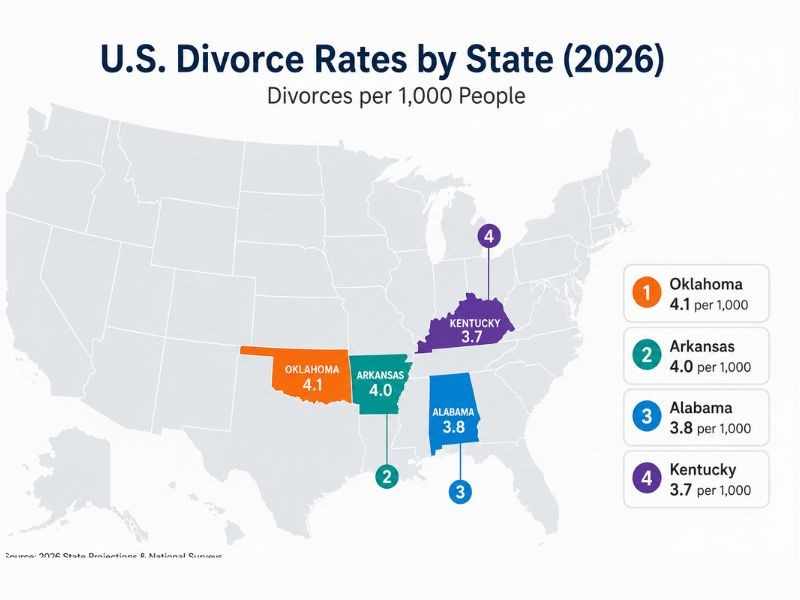
Meanwhile, northeastern states continue to report lower divorce levels. Massachusetts recorded one of the nation’s lowest divorce rates at around 1.5 per 1,000 people.
Why Are Divorce Rates Falling?
Family experts say several social and economic factors are driving the decline:
- Americans are marrying at older ages
- Higher education levels correlate with more stable marriages
- Couples increasingly live together before marriage
- Financial planning before marriage has become more common
- Fewer young adults are rushing into marriage
According to research, first marriages are now lasting longer on average, reaching around 8.2 years nationally.
However, “gray divorce” — divorces among adults over age 50 — continues to rise in the United States. Researchers say divorce rates among older couples have more than doubled since the 1990s.
Economic Stress Still a Major Factor
Analysts note that economic instability remains one of the biggest contributors to divorce in America. States with higher poverty rates, lower household incomes, and earlier marriage ages often report higher divorce levels.
A recent stress ranking study also linked family stress, financial hardship, and divorce rates in several southern U.S. states.
Experts believe the future of marriage in America will increasingly depend on economic conditions, social expectations, and changing attitudes toward long-term relationships.
Meanwhile, northeastern states continue to report lower divorce levels. Massachusetts recorded one of the nation’s lowest divorce rates at around 1.5 per 1,000 people.
Why Are Divorce Rates Falling?
Family experts say several social and economic factors are driving the decline:
- Americans are marrying at older ages
- Higher education levels correlate with more stable marriages
- Couples increasingly live together before marriage
- Financial planning before marriage has become more common
- Fewer young adults are rushing into marriage
According to research, first marriages are now lasting longer on average, reaching around 8.2 years nationally.
However, “gray divorce” — divorces among adults over age 50 — continues to rise in the United States. Researchers say divorce rates among older couples have more than doubled since the 1990s.
Economic Stress Still a Major Factor
Analysts note that economic instability remains one of the biggest contributors to divorce in America. States with higher poverty rates, lower household incomes, and earlier marriage ages often report higher divorce levels.
A recent stress ranking study also linked family stress, financial hardship, and divorce rates in several southern U.S. states.
Experts believe the future of marriage in America will increasingly depend on economic conditions, social expectations, and changing attitudes toward long-term relationships.