
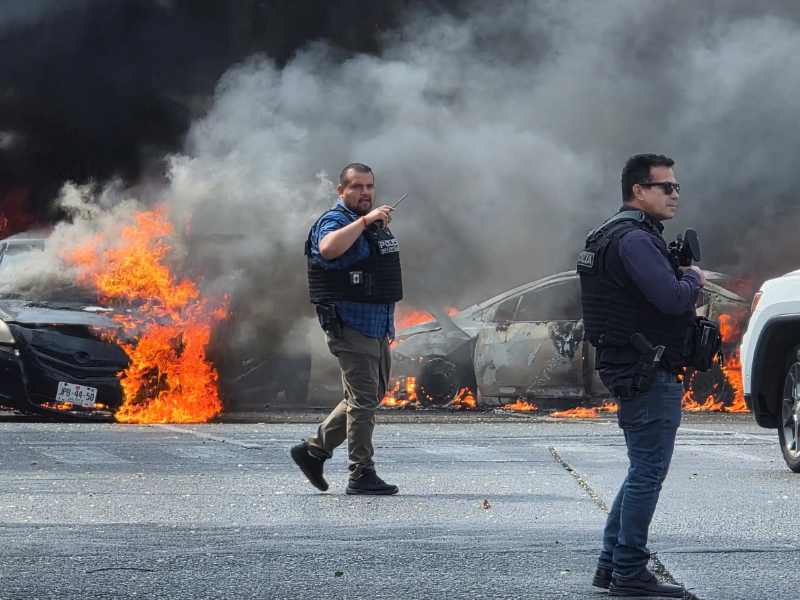
Mexico is currently in the grip of a serious security crisis marked by widespread violence, transportation paralysis, foreign travel warnings, and national uncertainty following the death of one of its most notorious drug cartel leaders.
On Sunday, February 22, 2026, Mexican military forces carried out a high-profile operation in Tapalpa, Jalisco, resulting in the death of Oseguera Cervantes, the longtime head of the Jalisco New Generation Cartel (CJNG). El Mencho, long regarded as Mexico’s most-wanted man and a central figure in the global fentanyl trade, was killed during a shootout along with several cartel members. The operation reportedly received intelligence support from the United States, underscoring renewed bilateral cooperation.
Wave of Retaliatory Violence
The killing immediately triggered coordinated retaliation from suspected CJNG factions. Armed groups launched attacks across multiple states, including:
- Setting fire to buses, private vehicles, businesses, gas stations, and supermarkets
- Blocking highways and major roads, with reports of more than 250 narcobloqueos nationwide
- Ambushing and clashing with security forces
At least 25 members of Mexico’s National Guard were reportedly killed in retaliatory attacks, primarily in Jalisco, with additional casualties in states such as Michoacán. Overall death toll estimates from the initial raid and subsequent violence have reached as high as 62 in some reports.
The unrest initially spread across more than half a dozen states before expanding to around 20, including Jalisco, Colima, Michoacán, Guanajuato, and others.
Major Cities Paralyzed
Cities such as Guadalajara effectively became ghost towns on Sunday. Residents stayed indoors, businesses closed, schools were shut preemptively, and public transportation was suspended. Panic scenes were reported at airports in Guadalajara and Puerto Vallarta, where flight cancellations caused chaos among travelers.
Popular tourist destinations, including Puerto Vallarta, experienced severe disruptions. Reports described burning vehicles and tense conditions in surrounding areas. Major airlines, including United Airlines, American Airlines, and Air Canada, temporarily suspended flights to affected regions. Numerous American and Canadian tourists were advised to shelter in place, with some remaining stranded in hotels.
International Security Alerts
The U.S. Department of State issued urgent security alerts, expanding shelter-in-place advisories for U.S. citizens to cover more than half of Mexico’s states. U.S. government personnel in several areas were also instructed to shelter, and a 24/7 crisis hotline was activated. Canada and other governments released similar warnings.
Government Response
Mexican President Claudia Sheinbaum addressed the nation on Monday, February 23, stating that “peace, security, and normalcy” were being restored. She reported that road blockades had been cleared and that no new major incidents occurred overnight. Flights and schools are expected to resume gradually, with full normalization anticipated by Tuesday.
Authorities characterized the violence as a predictable cartel tactic aimed at sowing chaos in response to high-profile arrests or killings. However, analysts warn that the death of El Mencho could trigger internal power struggles within the CJNG or prolonged instability.
Economic and Global Implications
The unrest comes at a sensitive time. Guadalajara is scheduled to host matches during the upcoming 2026 FIFA World Cup, raising concerns about security preparedness. The crisis also unfolds amid ongoing U.S.-Mexico discussions on trade, security cooperation, and fentanyl trafficking.
In the short term, tourism — a critical sector for Mexico’s economy — is expected to suffer. Prolonged instability could also disrupt manufacturing operations in Jalisco, a key hub for electronics and semiconductor production, as well as cross-border trade and logistics.
Situation Stabilizing, But Risks Remain
As of February 23, 2026, violence appears to be decreasing in several areas, with infrastructure gradually reopening. However, the episode highlights the enduring power of criminal organizations in Mexico and the fragile balance between security operations and cartel retaliation.
Authorities are urging citizens and travelers to closely monitor official advisories before planning or continuing travel to affected regions.