
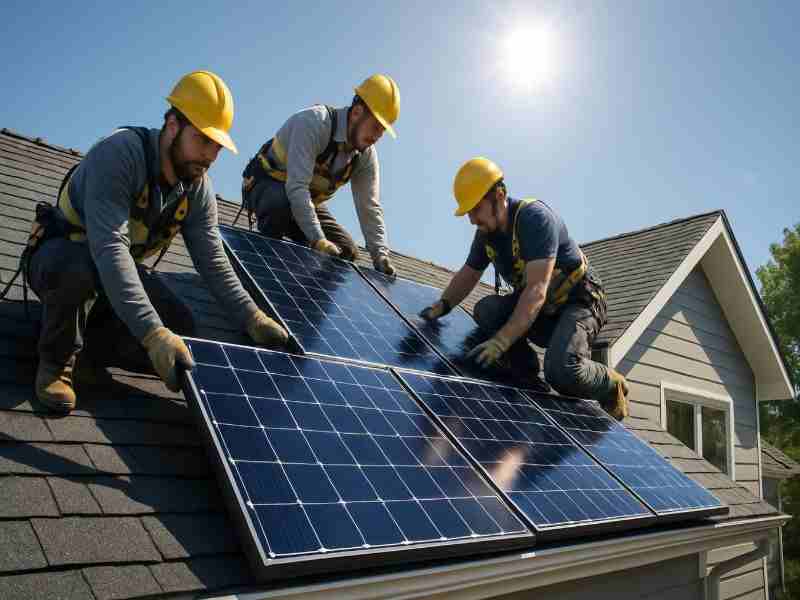
ANTALYA, Turkey, Nov. 11, 2026 — A coalition of countries has backed an ambitious plan to double the number of homes worldwide equipped with rooftop solar panels by 2030, as governments gathered at the COP31 United Nations climate summit seek ways to reduce energy costs and accelerate the transition away from fossil fuels.
The Global Rooftop Solar Declaration, launched Tuesday at the climate conference in Antalya, aims to increase the number of solar-powered households from approximately 150 million today to at least 300 million by the end of the decade.
Australia, Bangladesh, Kenya, Nigeria, Palau and Vanuatu have endorsed the initiative, which seeks to make solar electricity more affordable and accessible to households across developed and emerging economies.
The declaration has also attracted support from 34 lawmakers across 21 countries and Indonesia’s state-owned electricity company, PT PLN.
Supporters say widespread rooftop solar adoption could help households reduce their electricity bills, protect consumers from volatile energy prices and improve access to power in underserved communities.
The announcement comes as countries face growing pressure to deliver meaningful climate action following another year of damaging weather disasters and global energy disruptions.
Global Solar Plan Targets 300 Million Homes by 2030
The declaration represents one of the major renewable energy initiatives announced during the early days of COP31.
Its central objective is to double the global number of solar-powered households within the next four years.
Unlike large solar farms, which generate electricity at centralized facilities, rooftop solar systems allow households to produce electricity directly where it is needed.
These systems can reduce reliance on conventional electricity networks and, when paired with batteries, help provide backup power during outages.
The Global Solar Council argues that expanding rooftop solar can simultaneously address rising living costs, energy security concerns and climate change.
Sonia Dunlop, chief executive of the Global Solar Council, said the technology offers families a practical way to reduce their dependence on increasingly expensive traditional energy supplies.
The initiative also aims to accelerate deployment by simplifying installation permits, lowering upfront costs and expanding the availability of skilled workers.
Bangladesh Joins Global Solar Initiative
Bangladesh is among the countries supporting the declaration, highlighting its growing interest in renewable energy and decentralized electricity generation.
At the COP31 announcement, Bangladesh’s Power Division Secretary Mirana Mahrukh outlined the country’s ambition to develop 5,500 megawatts of rooftop solar capacity by 2030.
The government’s indicative implementation pathway covers approximately 870,000 rooftops.
Under a proposed financing arrangement, about 20% of installations would be supported through domestic efforts, while the remaining 80% would depend on international cooperation and investment.
This would mean approximately 174,000 rooftops supported domestically and another 696,000 requiring international assistance.
Bangladesh has called on international partners to help mobilize affordable financing, advanced technology and private investment.
For a country facing growing electricity demand and exposure to volatile fossil fuel prices, rooftop solar could help diversify its energy supply while reducing pressure on conventional power generation.
Why Rooftop Solar Could Lower Household Electricity Bills
Rising electricity prices have become a significant concern for households worldwide.
Energy disruptions linked to the Russia-Ukraine war and the conflict involving Iran have increased interest in alternatives to imported fossil fuels.
Solar panels allow households to generate electricity during daylight hours, potentially reducing the amount of power purchased from the grid.
Battery systems can store surplus energy for use at night or during periods when electricity supply is disrupted.
The financial benefits depend on installation costs, local electricity tariffs, financing options and government policies.
In some markets, rooftop systems can substantially reduce long-term household electricity expenses.
However, the initial cost of solar panels and battery storage remains a major barrier for lower-income families.
Supporters of the declaration are urging governments to introduce financing programs, subsidies and regulatory reforms that can make installations accessible to more households.
Australia Shows How Rooftop Solar Can Expand
Australia has emerged as one of the world’s leading markets for residential rooftop solar.
Approximately one in three Australian homes now has rooftop solar panels, while more than 700,000 households have installed battery storage systems.
The country’s experience has become an important example for governments seeking to expand decentralized renewable electricity generation.
Australian Climate Change and Energy Minister Chris Bowen has argued that rooftop solar can help reduce household power bills while strengthening national energy security.
Australia’s support for the Global Rooftop Solar Declaration reflects an effort to extend the technology’s benefits to emerging economies.
Despite its rapid solar expansion, Australia continues to rely heavily on coal for electricity generation and remains a major exporter of fossil fuels.
That contrast highlights the challenges facing countries seeking to increase renewable energy capacity while maintaining existing electricity systems.
COP31 Pushes Global Electrification Target for 2035
The rooftop solar initiative forms part of a broader effort to accelerate electrification.
Turkey, which is hosting COP31 with Australia leading the negotiations, has promoted a plan to increase electricity’s share of global final energy consumption to 35% by 2035.
The proposal, known as the 35-by-35 Global Electrification Pledge, seeks to encourage the use of electricity in transportation, buildings, heating and industry.
Supporters argue that combining electrification with renewable energy can reduce dependence on fossil fuels while improving energy efficiency.
Electric vehicles, electric heating systems and industrial electrification could all benefit from an expanded supply of renewable electricity.
However, delivering the target would require major investments in electricity networks, storage systems and power generation infrastructure.
Coal Remains a Major Challenge for Renewable Energy Goals
Although solar and wind power are expanding rapidly, fossil fuels still account for a substantial share of electricity generation in many countries.
Turkey has invested heavily in renewable energy, with solar and wind accounting for nearly 23% of electricity generation.
Coal nevertheless remained the country’s largest individual electricity source last year, contributing approximately 33% of total generation.
Australia faces a similar challenge.
Despite its strong rooftop solar market, coal continues to supply more than 40% of the country’s electricity.
Energy industry representatives have warned that expanding renewable capacity without sufficient grid upgrades and storage investment could create reliability problems.
The challenge is especially significant because electricity demand is rising in many economies as transportation, industry and households become increasingly electrified.
China and India Face Grid and Energy Storage Problems
China and India have installed enormous amounts of renewable electricity capacity in recent years.
Both countries have experienced periods when electricity networks could not fully absorb the energy produced by solar and wind installations.
This can result in renewable power being curtailed, meaning electricity generation is reduced because transmission networks or storage systems cannot accommodate the available supply.
Energy experts say improving grid capacity and accelerating battery deployment will be essential for making large-scale renewable expansion effective.
Without those investments, countries could continue installing solar systems while losing some of the electricity they are capable of producing.
The Global Rooftop Solar Declaration therefore emphasizes the need to improve infrastructure alongside the deployment of new solar panels.
Solar Energy Expands Across Southeast Asia
Rising fuel costs have also encouraged countries across Southeast Asia to accelerate renewable energy investment.
Indonesia has announced plans to install 100 gigawatts of solar power by 2029.
Thailand and Vietnam have introduced incentives to support rooftop solar development, while the Philippines has become an important destination for Chinese solar technology exports.
The region’s reliance on imported energy has increased interest in domestic alternatives, particularly after disruptions to shipping and fuel supplies connected with the conflict involving Iran.
Solar energy offers a potential way for countries to reduce exposure to global oil and gas price fluctuations.
However, developers and consumers still face obstacles involving financing, installation costs, government approvals and electricity grid connections.
Rooftop Solar Could Help Remote Communities and Disaster Zones
Beyond lowering household bills, rooftop solar could improve electricity access in communities that are difficult to connect to centralized power networks.
Remote villages, islands, refugee settlements and disaster-affected regions can benefit from decentralized renewable electricity systems.
When paired with batteries, solar panels can support essential services such as lighting, refrigeration, communications and medical equipment.
In developing countries, these systems may provide electricity to households and businesses that lack a reliable connection to the national grid.
Nigeria has already expanded decentralized solar electricity access to millions of people, illustrating the potential for renewable systems to support communities outside major urban centers.
COP31 Solar Pledge Faces Implementation Test
Despite the ambitious target, the Global Rooftop Solar Declaration is voluntary and legally non-binding.
Governments are not required to meet specific installation targets simply because they endorse the agreement.
Energy experts say the initiative’s success will depend on whether countries translate their commitments into practical policies.
Key requirements include affordable financing, government incentives, qualified installers, modern electricity networks and sufficient battery storage.
Developing countries may also require financial support from international institutions and wealthier economies.
Without coordinated investment and regulatory action, the target of 300 million solar-powered homes could prove difficult to achieve.
The COP31 talks in Antalya will continue with governments negotiating broader climate financing, renewable energy and emissions-reduction commitments.


