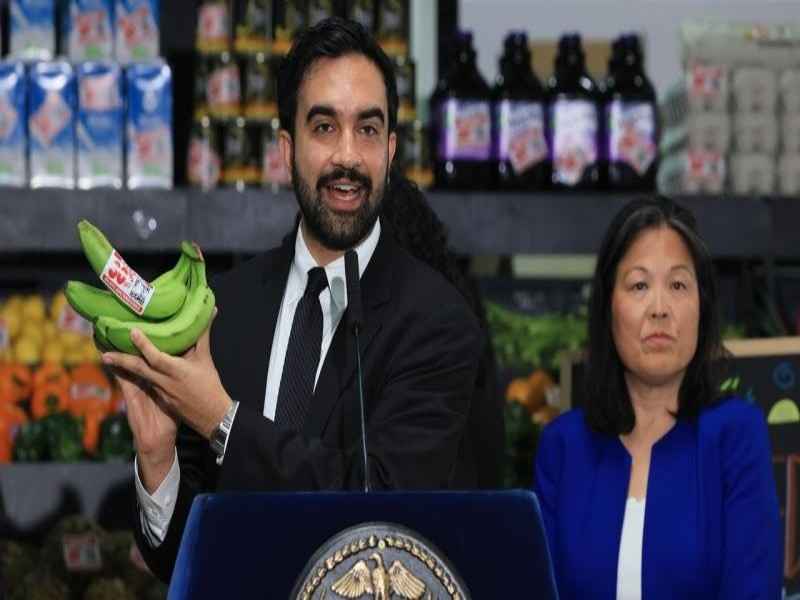
New York — New York City Mayor Zohran Mamdani’s plan to open five government-owned supermarkets has sparked a broader debate over the role of government in people’s everyday lives. Whenever Mamdani reveals new details about the proposal, an old image of former Soviet leader Boris Yeltsin often resurfaces on social media.
The photographs were taken during Yeltsin’s visit to the United States in 1989, just months before the collapse of the Soviet Union. During the trip, Yeltsin made an unexpected visit to a Randall’s supermarket in Houston and was reportedly stunned by the variety of food available.
He sampled free cheese, examined the seafood section and left the store carrying a goodie bag. According to his biography, Yeltsin later sat quietly on the flight, with his head in his hands, reflecting on the empty shelves and limited food choices in Soviet markets. He reportedly asked what had been done to the Soviet people.
The story has become a powerful symbol in the debate over Mamdani’s proposal. Critics argue that America’s supermarkets represent one of the great successes of the free-market system. They question whether a government-run grocery store could provide the same level of choice, efficiency and abundance offered by major private retailers such as Walmart and Costco.
Some opponents have even imagined so-called “Mamdani marts” becoming poorly stocked government stores reminiscent of the Soviet era.
But supporters of the plan say the comparison misses the point. The debate, they argue, is not simply about what brands will be placed on supermarket shelves or how much consumers will pay for eggs. Instead, it reflects a much deeper disagreement over what government should provide for its citizens.
Nevin Cohen, an associate professor at the CUNY School of Public Health, said the debate is essentially a test of competing ideas about the responsibilities of government.
Mamdani’s proposal is also not entirely unprecedented. New York City has a history of government involvement in food markets.
Former Mayor Fiorello La Guardia, one of Mamdani’s political inspirations, promoted government intervention during the New Deal era. In the 1930s, La Guardia established a network of city-run indoor markets despite opposition from private businesses.
The markets were designed to move pushcart vendors off the streets while helping reduce grocery costs. Several of those public markets remain open today.
Mamdani now wants to transform vacant, city-owned properties into public grocery stores.
The proposed supermarkets would not necessarily be operated entirely by the government. The city plans to work with private operators to manage the stores and source food.
Supporters argue that the initiative could help address food insecurity and high grocery prices, particularly for New Yorkers struggling with the rising cost of living.
Critics, however, say the city should focus on making it easier for private retailers to expand or help low-income residents access existing private-sector options.
The American supermarket has long represented more than a place to buy food. Over decades, it became a symbol of consumer choice, economic prosperity and the American way of life.
Between 1960 and 2010, the number of different products available in an average U.S. supermarket increased dramatically, from around 6,000 to approximately 47,000. Business models such as Walmart supercenters, Costco warehouse clubs and Trader Joe’s specialty stores expanded consumer choice even further.
Historian Tracey Deutsch of the University of Minnesota, who studies food and capitalism, said food can be a powerful symbol of political values.
Grocery stores have also played important roles in major social and political moments, including the civil rights movement and the COVID-19 pandemic.
For Mamdani, the supermarket proposal fits into a broader political philosophy: using government to address everyday problems faced by ordinary people.
He has pointed to La Guardia’s legacy as an example of government taking direct action to improve residents’ lives.
The success or failure of Mamdani’s plan will ultimately depend on how the proposed stores perform in practice—whether they can offer lower prices, maintain a wide selection of products and attract enough customers to justify the investment.
For now, however, the controversy surrounding the plan is about much more than grocery shopping.
It has become a new battleground in the long-running American debate over free markets, government intervention and how much responsibility government should take for improving the daily lives of its citizens.